

On a Monday morning the AI assistant in a small company is as clever as it was on Friday and remembers none of it. Ask it to draft a payment reminder and it writes a good one in seconds. Nobody asked, because nobody noticed that the invoice was still unpaid. The assistant answers questions well. It does not go looking for the questions.
We built ourselves the part that goes looking: a company brain made of plain files and two scheduled AI routines that check the company every evening and every Monday. We run our own company on it, and we have published the structure as an open template under the MIT licence: solutionplus-dev/company-brain on GitHub. It contains no data of ours; the example inside is a made-up company.
We work in three parts of applied AI: AI positioning, which is how assistants and buying agents see a company from outside; AI applications, which is custom software with AI built into it; and the company brain, which is AI that runs the recurring operations of a company. This post is the deep dive on how the brain runs: its routines and rules.
Why we built it: so you never rebuild the context
Working with AI assistants has taught people an odd habit. Before you ask anything, you assemble the background: who the client is, what was decided last month, which numbers matter. The better you are at it, the better the answer, and the more of your day goes into briefing a tool.
A colleague or a co-founder does not need that briefing. You say half a sentence and they know the rest, because they were there. That is the standard we built the brain for: you have a thought, you say it, and the agent already has the context.
So the rule we follow ourselves is to hold nothing back and throw it in. A half-formed idea, a worry about a client, a question you keep circling, a link you meant to read. Say it to your agent, or drop it as a file into the brain's inbox folder. The agent reads it against what the brain already holds (the client file, the decisions on record) and gives back something you can work with. The evening run files it where it belongs.
Setting it up starts with questions, too. The init script asks for the company, the time zone and each legal entity, and the source list tells the agent where to look. The more of your preferences and rules you write down, the less you explain later.
The second reason is that it runs without you. Two routines are scheduled, and nobody has to open a chat for them to happen. Each week the brain also works on itself: it evaluates what it missed, cleans up, audits itself, and on Saturday it "dreams", which means it reads the whole week to find what no single evening showed. If a step did not finish, Monday's run catches it up. It proposes changes to its own rules and applies only the ones you answer with a written yes. Every week it has more to work from, because each correction and each idea you threw in is a file the next session reads. That week is described further down.
It is not tied to one tool. The rules and routines are Markdown files, so any agent that can read a folder can run them. We run ours with Claude Code. The same folder works with Muse Code, and an always-on agent such as Grok Bot, which keeps its own computer running, can carry the two routines while your laptop is closed.
What does an AI assistant not do on its own?
Check. An assistant works when someone opens a chat and asks. The work that hurts a small company is the work nobody asks about: the receipt that arrived and was never filed, the client request buried in a thread, the reply promised last week, the deadline that moved closer while everyone was busy. Surveys of small business owners keep finding the same thing, that admin and compliance eat time owners would rather spend elsewhere (Federation of Small Businesses, Talker Research for Adobe Express).
The usual answer is an automation, and automations have a quiet failure mode. Zapier's own help page on a Zap that is not running describes when the service switches a workflow off after repeated errors. On the Make forum, a user asked how to find out when a scenario silently stopped running because a connection expired; the answer was that there is no built-in notice for that, so you build a watchdog. An automation that stopped looks exactly like a quiet week.
We wanted a routine that reports every evening and says out loud when it could not look. For fixed, predictable steps, plain rules are still the better tool (see workflow automation without AI); the company brain sits above those steps and tells a person what needs them.
Put the company in plain files
The brain is a folder. Finance and operations sit at the core, then clients, meetings, sales and marketing, each module with its own AGENTS.md rule file, so any agent that opens a folder knows what it owns and what it must never do. We wrote about the general idea, Markdown with statuses, a SQLite index, small rule-checking tools and masking, in how we build AI knowledge bases. The template is the operating version of that idea.
Its main rule is one home per fact. Deadlines live in DEADLINES.md. Recurring duties live in finance/OBLIGATIONS.md. Money that moved lives in one journal per legal entity, with a source document for every line. A file called SYSTEM_OF_RECORDS.md lists every kind of fact and the one file that owns it. When two files disagree, the owning file wins until evidence says otherwise, and the disagreement becomes a numbered open point instead of a silent overwrite.
Originals stay as they arrived. A PDF invoice gets a .digest.md beside it, a short plain-text reading the agent writes when filing, so search can find it. The digest never owns a fact; for anything legal or financial the agent opens the original.
Every figure carries its source and a certainty label: statement, proof, calculated, booked, unverified or unknown. Unknown stays unknown, with a note on what would confirm it. An agent that is allowed to guess a date will guess one, and a guessed date in a deadline register is worse than an empty field.
Two routines, each a file
The whole daily routine is one readable file, 00_Brain/SCHEDULES/daily.md. The scheduler in your agent tool does not hold any logic. Its entire prompt is one sentence: read this file and execute it. If you want to change what happens every evening, you edit a Markdown file and git shows when it changed. The routine file is part of the software around the model, and same model, different software shows how much that part can decide.
The evening run starts with a preflight: one cheap call per source (mail, bank notifications, the notetaker, the calendar, the downloads folder) and a table of what answered. Then it works through 19 checklist items: invoices and receipts filed under the right legal entity, post, authorities, client requests, replies owed, bank signals matched to open invoices only when a bank message proves the payment, what is due in the next 14 days, the day's meetings, deadlines ranked by what a miss would cost, new files with a digest each, and finally the index refresh.
It ends by writing the owner one page, TODO.md, for the next morning: at most seven actions, the costliest first, each with the reason and the file. Before rewriting that page it copies every answer the owner wrote on yesterday's page into the right register, so a "yes" scribbled beside a proposal is never lost to the next run.
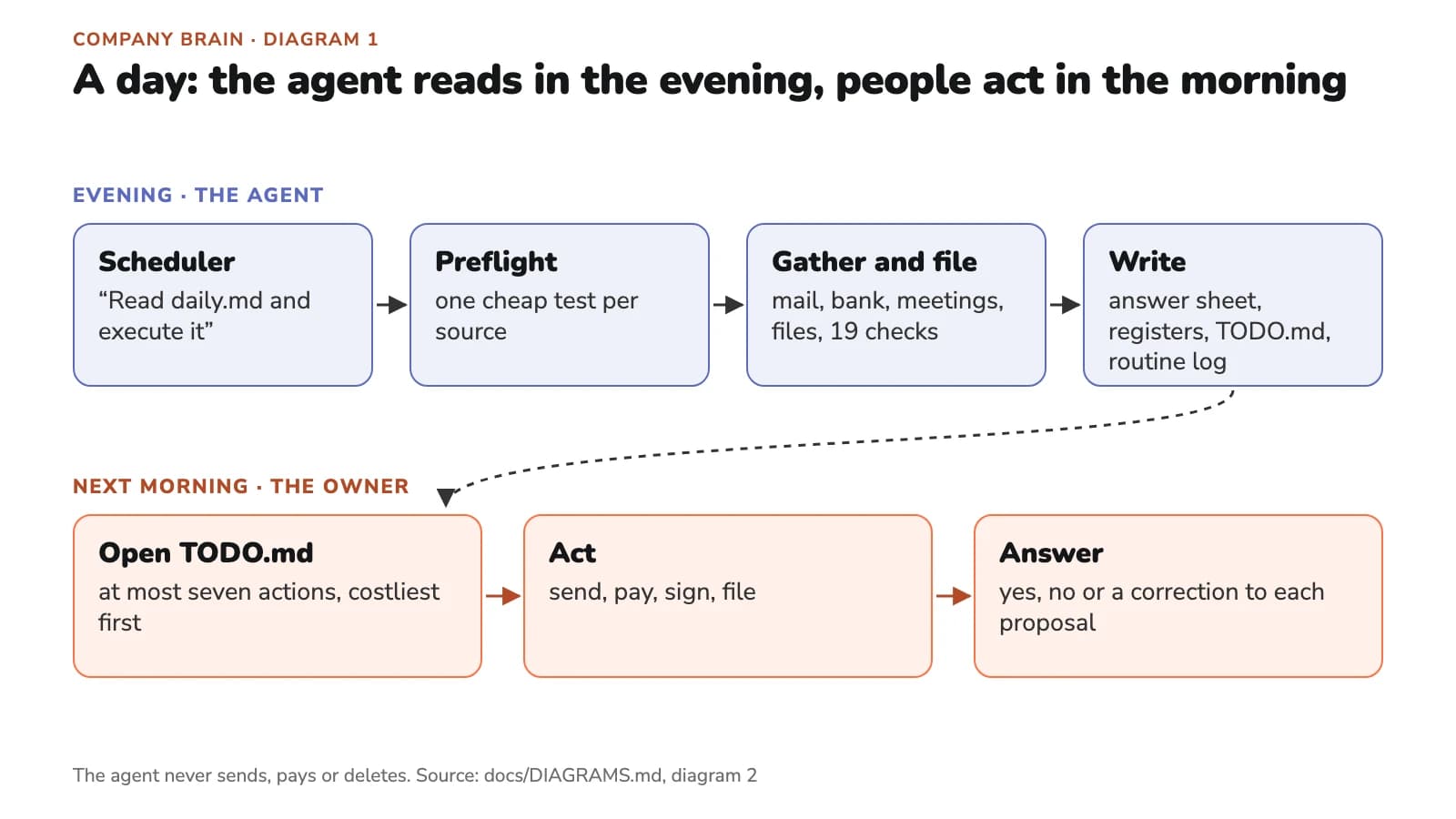
The Monday run, weekly.md, looks forward instead: the week and month ahead, a finance week per legal entity, cleanup, and the catch-up for any weekday block that did not finish.
Why "not read" is an answer
Every evening ends with an answer sheet of twelve questions, always the same twelve, each answered Yes, No or Not read with the one fact that matters and the file where it is saved:
| Question | Question | ||
|---|---|---|---|
| a | Did an invoice or receipt arrive? | g | Do we owe anyone a reply? |
| b | Did post arrive at the registered office? | h | Is a tax reply or filing due? |
| c | Is there an unsent draft waiting? | i | Is a deadline within 14 days? Which is the costliest? |
| d | Did a client or prospect ask for something? | j | Is anything to pay within 14 days? |
| e | Was an invoice paid? | k | Was a meeting held, and is it filed? |
| f | Is an invoice open, overdue, in draft or due to be raised? | l | Which sources were not read? |
The third answer is the reason the sheet exists. If the mail connector was signed out, the answer to "did an invoice arrive" is Not read, never No. A No means the agent looked and found nothing. A Not read means it could not look, and it carries the exact error. The rule is written into the root AGENTS.md: a source that could not be read is reported as "not read", never as "nothing new".
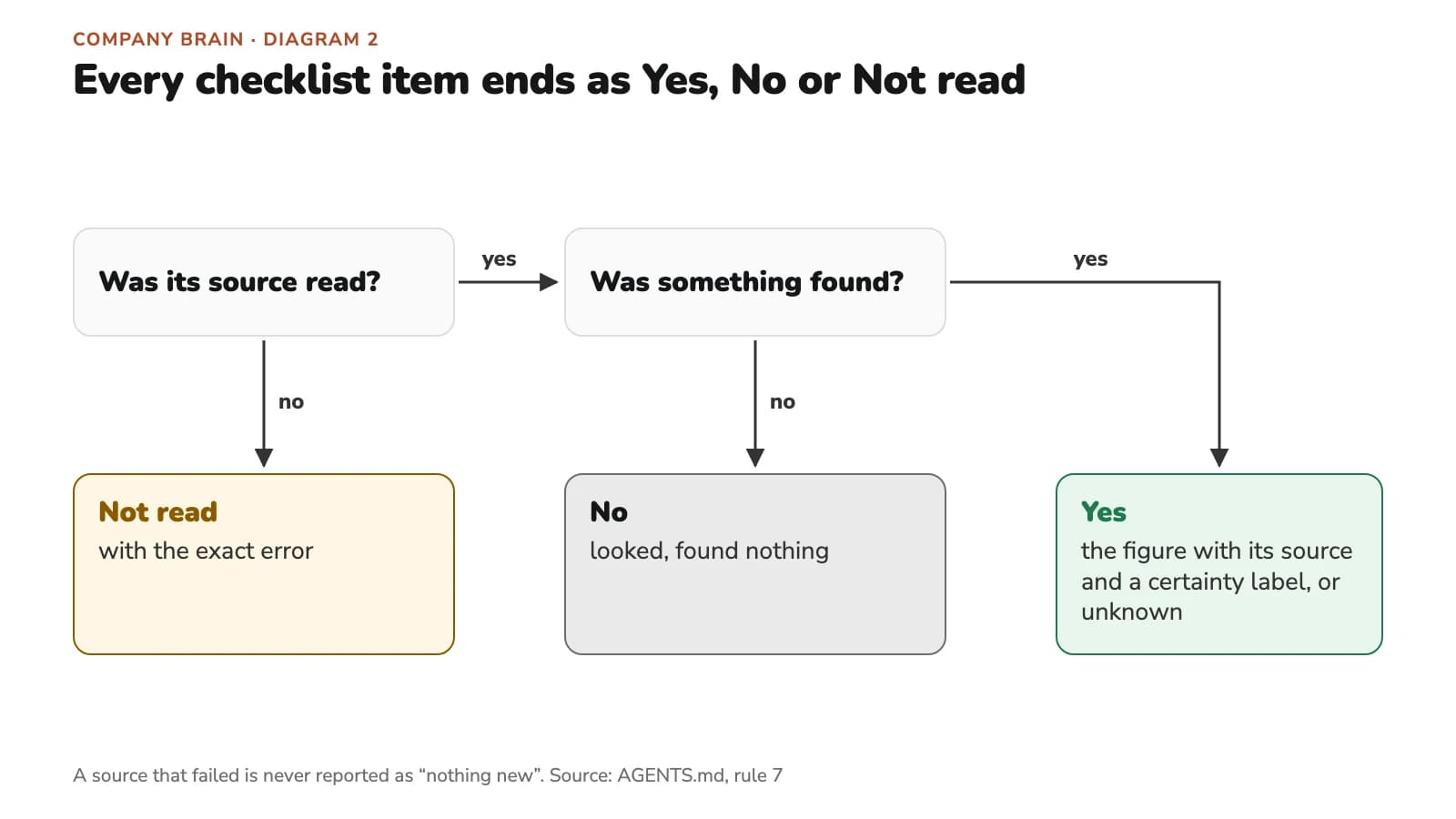
This is the honest version of the silent automation problem. You see the gap every evening until you close it. The setup guide is blunt about the first week: expect many Not read and unknown answers, because each one is a source to connect or a document to find.
The agent drafts, people act
The agent may not send, reply, pay, post, delete or submit anything to an authority. It reads the outside systems, puts documents in their place and drafts. A person sends, pays, signs and files. The rule file says it in one line: agents draft; the owner sends, pays and files.
That line costs some convenience, and we keep it on purpose: a reminder a person sends after a glance is slower, and it never goes to the wrong client on the wrong day. In the AI gold rush has quietly moved somewhere else we argued that the scarce skill is deciding which decisions route back to a person. Here that decision is written down once, in the hard rules, instead of being made again in every workflow.
The same file says never delete: duplicates are listed with the exact command for the owner to run. Credentials are listed by file name and never opened.
A brain that works on itself
The daily run ends with one block of work on the brain itself, a different block each weekday, and none of them changes a rule by itself.
Tuesday it evaluates the past week: sources it failed to read, questions answered Not read, every place the owner corrected it, and whether its own search finds the right file for a list of standing questions. That gives a score line to compare with the week before. Wednesday it enriches: digests for important new documents, one knowledge note, the stalest client file and any recurring duty the mail revealed. Thursday it cleans up, folding closed months into rollups and preparing (never switching) rollovers for registers that grew too long. Friday it audits itself, including whether the diagrams still match the routine files.
Saturday it dreams. The name is grander than the job, which is sober: the agent reads the whole week, every daily log, the evaluation, the audit and the owner's corrections, and writes down what no single evening could see. A client going quiet. A cost creeping up. The same question asked twice. Two runs applying the same rule differently. It sorts these into five buckets (notice, knowledge, rules, routines, for the owner), at most three entries each, every entry with its evidence and the exact change it proposes. It applies nothing.
Sunday it turns the findings into at most five proposals in IMPROVEMENTS.md, each with the evidence, the exact new wording and how next Tuesday's evaluation will show whether it worked. They appear on Monday's page under "The brain suggests". The owner writes yes, no or a correction. Monday's block applies the yeses exactly as written, and the following Tuesday checks whether the number moved. A change that made things worse comes back as a proposal for the way back.
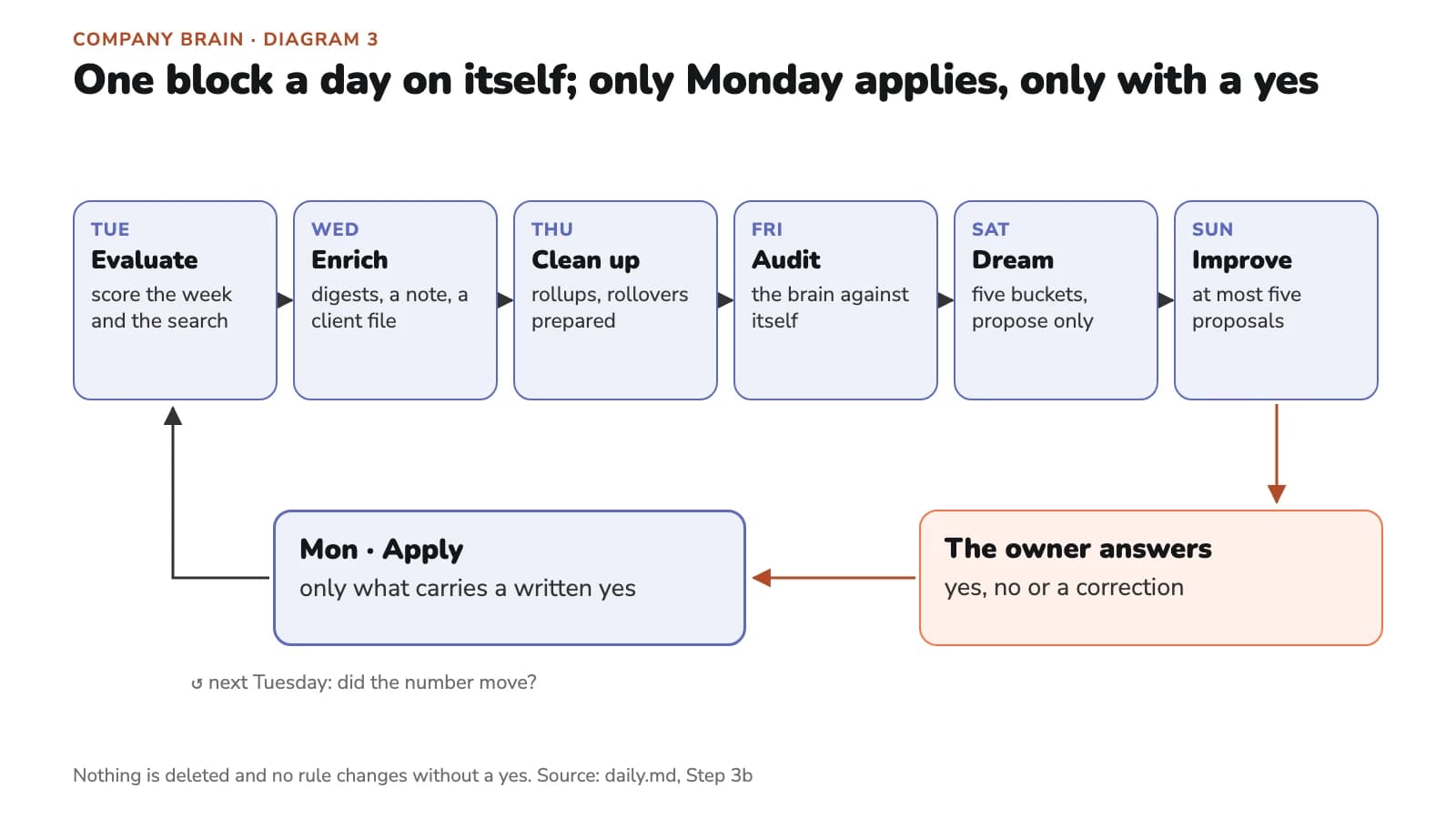
We like this loop because it is boring: no fine-tuning, no hidden memory, only Markdown files with proposals, answers and a score you can read.
Two companies, never one sum
Some small companies have two legal entities, an operating company and a second one for another market or another line of business. The template asks for each entity at setup and keeps them apart by rule: no money line, sum or currency column ever holds two, one currency per column, never converted. Which entity bills which client is the owner's recorded decision, and an agent never moves a client. Where code can enforce it, code does: the test suite includes a check that the ledger never mixes entities.
Finding things: an index on your laptop
tools/index/ builds a SQLite catalogue of every file with full-text search, plus business records read from the registers (deadlines, to-dos, decisions, meetings, clients, people, ledger lines). It uses only the Python standard library. scripts/brain ask "what is due this month" is the everyday entry point.
Search by meaning is optional and runs locally on Apple silicon, with a small multilingual model (about 1.1 GB to download). Text is redacted before it is embedded and never leaves the computer. Each chunk is stored as a 96-byte code for a fast first pass, then the shortlist is re-ranked exactly. The repository publishes what was measured on the brain the template was drawn from, including the weak number: the exact top ten was inside the shortlist 97 % of the time, but a question and its translation into the other language shared only 18 % of their top-ten results. The small model finds well within one language and poorly across two, so measure it on your own files with the included evaluation script before you rely on it.
What it is not
It is not a bookkeeper, a tax adviser or a lawyer, and it does not replace one. It keeps papers in order and asks good questions; tax and legal conclusions stay with people who are licensed to draw them.
It is not finished. The public repository is one commit, with 16 smoke tests and 21 diagrams. The optional shared store's SQL was generalised from a working setup and has not been run in this form; the documentation says to treat it as code you review yourself.
It is not about how the outside world sees you. How AI assistants and buying agents see your company from the outside is a separate question; we cover it in AI positioning.
It is not a product with an installer. You need an AI coding agent, a scheduler, and someone comfortable running a few commands in a terminal. And we do not have a measured number for time saved, so we do not quote one.
How to try it
git clone https://github.com/solutionplus-dev/company-brain.git my-company-brain && cd my-company-brain
python3 scripts/init.py            # company, time zone, legal entities
python3 tools/index/refresh.py     # build the index
scripts/brain ask "what is due this month"
The init script asks for the company name, the time zone and each legal entity. Then list your sources in 00_Brain/SOURCES.md (which connector or folder, a cheap test, no passwords), enter the recurring duties and clients you already know, and run daily.md once by hand before you schedule anything. Which connectors to use, and how the same brain works with Claude Code, Codex or Cursor, is the subject of company brain in practice. Keep your own brain in a private repository, never a public fork. If a whole brain is more than you want to start with, our AI implementation playbook begins with one painful workflow instead.
Where this came from
The template was written from the brain we run SolutionPlus on, with every name, figure and client removed. Its starting point is GTM Brain, an MIT-licensed company brain that keeps go-to-market context as files an agent can query; we extended the same idea to finance, operations and the whole company, and the repository's CREDITS.md says so. Open projects such as GBrain and Sylph approach the problem from the memory side and the agent side. Ours is narrower: two routines, an answer sheet and a rule book for a small company's recurring work.
The company brain is one of our three parts of applied AI, next to AI positioning and AI applications built into a team's daily work, which our AI automation team builds.
If you want to look at the structure, open the repository on GitHub, clone it and run the daily file once by hand. If you would rather not set it up yourselves, tell us which tools and inboxes your company runs on, and we will set it up with you.
Frequently asked questions
Does the company brain need a specific AI tool?
No. The routines are Markdown files and the scheduler prompt is one sentence, so any coding agent that can read a folder and run a scheduled task can execute them. The template names Claude Code, Codex and Cursor. The optional search by meaning needs a Mac with Apple silicon; everything else runs on Python and SQLite.
Is my company data sent anywhere?
The files stay in your private folder. The index is a SQLite file on your computer, and the optional embedding model runs locally, so no text leaves the machine for search. What your AI agent sends to its model provider depends on the agent you choose. An optional shared store uploads text chunks and records, never files, and only for the scopes you allow.
Does it replace a bookkeeper or a tax adviser?
No. It keeps the papers in order, matches payments to invoices when a bank message proves it, lists what is due and says what it could not read. People send, pay, sign and file, and tax or legal questions go to an adviser as questions.
What if we have two companies?
The template asks for every legal entity at setup and keeps them apart: one folder and one ledger per entity, no line, sum or currency column that mixes two, and a test that fails if the ledger does. A company with one entity keeps the rule anyway, because the second one tends to arrive without warning.
Can a team use the same company brain?
Yes, in two ways. The folder can live in a private repository the team shares. For search across people, an optional Postgres store gives each row a scope such as finance, operations or one client, and each person sees only the scopes in their membership. Its SQL has not been run in the template form yet, so read it and run the included checks first.